How The BHAMM Study is making a difference
The Challenge
Women account for 51% of the adult world population and spend a larger portion of their lifespan in poorer health compared to men.
Despite this, women’s health remains one of the most underfunded research areas in healthcare – even for diseases that disproportionately affect women, such as Alzheimer’s disease (AD).
Why This Matters Now

Canada became a super-ager society in 2026
20% of the adult population are seniors. Advanced age is the number one risk factor for AD.

Disproportionate Impact
Nearly two-thirds of Alzheimer’s patients are women.

Underrepresentation in Research Leading to Poor Care Outcomes for Women
Historically, clinical studies have not adequately accounted for sex-based biological differences. As a result, women are disproportionately affected by drug side effects and little is known about how female sex and sex-specific life experiences, i.e. menopause, influence AD risk and symptoms.

Economic Burden
According to the World Economic Forum’s (WEF) 2025-2026 report AD costs the global economy $1.8T annually due to healthcare costs, productivity loss, and caregiving costs. This amount is anticipated to increase to $2.8T by 2030. However, by addressing the women’s brain health gap, including advancing our understanding of ‘why more women are diagnosed with AD?’, there will be a $1T boost to the Global GDP. Therefore, preventing AD in women will have a significant impact to our world economies.
Our solution
BHAMM is the only brain imaging study in Canada that has been using multi-modal MRI, genetic, multi-omic (blood biomarkers), psychosocial, and neuropsychological methods, to gain a holistic understanding of what factors affect midlife brain health and dementia risk during spontaneous menopause.
Importantly (1) blood biomarker, MRI, cognitive, psychosocial, and lifestyle data are time locked so we get a holistic snapshot of each participant 's brain-body-social well being at a single time; (2) menopause status is not determined retrospectively, nor is it based solely on self-report alone, but it is validated by hormonal measurements.
Our aims
- Determine how menopause transition and spontaneous menopause interact with dementia risk factors to influence brain health and AD risk at midlife.
- Identify midlife brain resilience factors that are both (a) generalizable across sexes, genders, and communities and (b) specific to sex, gender, and other diversity-related variables.

To develop sex-specific, personalized, clinical tools for the early detection of dementia and other age-related disorders at midlife – an age when interventions targeting prevention will be most beneficial
Where are we now
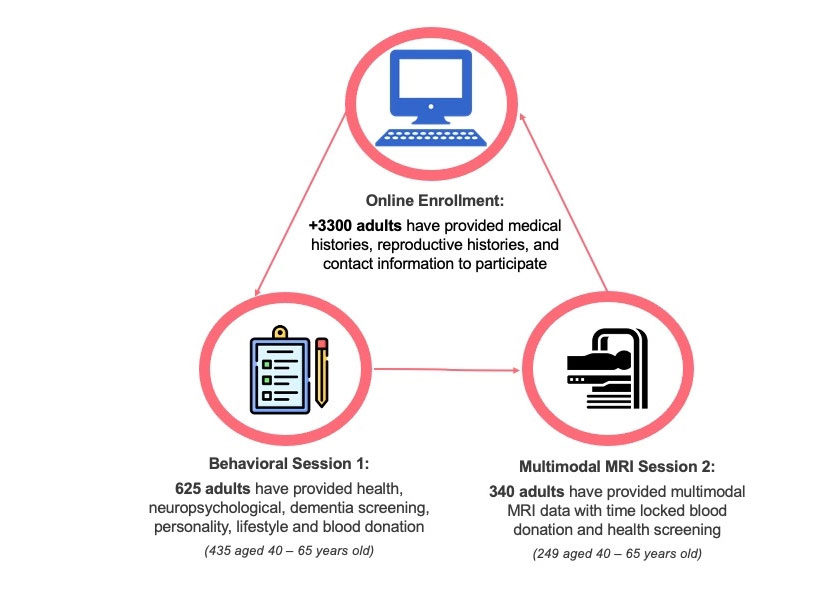
If you are interested in donating to the BHAMM Research Program or scheduling Dr. Rajah to speak at your next event, click the link below.
Contact Us